Data Centres
Thermal imaging can identify unequal phase behaviour and associated reliability concerns within electrical systems serving data centres.
Discover MorePhase imbalance occurs when electrical current or connected load is not distributed evenly across the three phases of an electrical system. Thermal imaging can make the resulting differences visible across conductors, protective devices, busbars, motor circuits and distribution equipment.
Phase imbalance is not necessarily a component defect in itself. It may reflect unequal single-phase loading, changes in operational demand, circuit allocation, supply conditions, drive output, cable or connection issues, or a developing problem within a three-phase motor.
Our electrical thermal imaging surveys assess equipment while it remains energised and operating under representative load. This page explains how phase imbalance appears thermally, what may cause it and why the thermal pattern must be considered alongside electrical measurements and equipment context.
The operational consequences vary according to the degree of imbalance and the affected asset. Persistent unequal loading can increase losses, raise neutral current, reduce motor efficiency, place additional stress on transformers and conductors, and reduce the reliability of critical electrical infrastructure.
Effective assessment considers current on each phase, comparable temperatures, equipment ratings, load type, duty cycle, system configuration and the consequences of failure. A warmer phase may indicate greater load, but it does not identify the underlying cause on its own.
For a wider overview, visit our Common Electrical Faults Identified by Thermal Imaging guide. Related load-related heating is covered separately in our Overloaded Circuits guide.
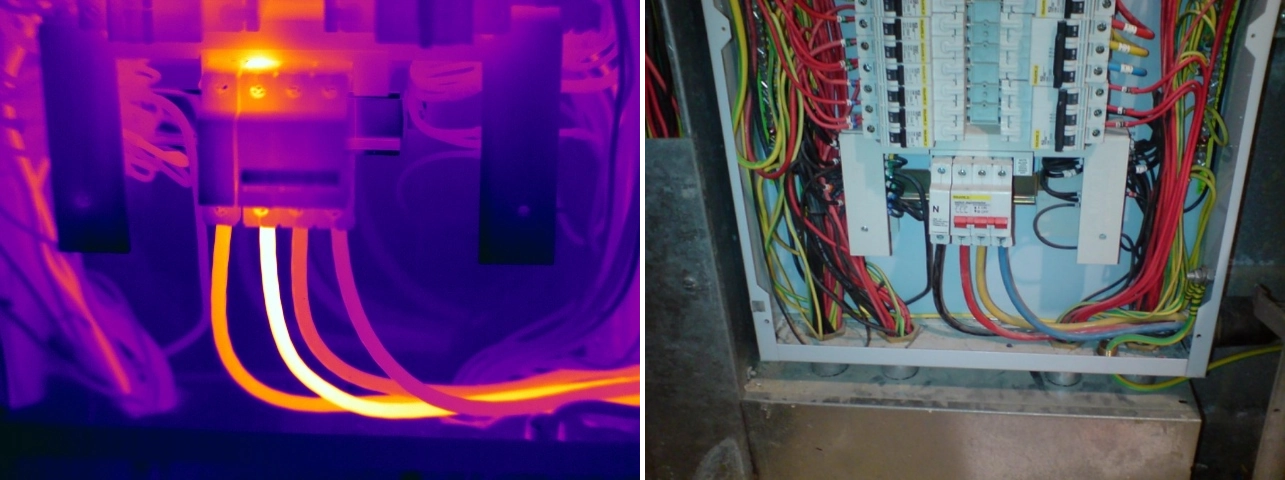
In a balanced three-phase system, currents and loads are distributed as evenly as practicable across L1, L2 and L3. When one phase carries more or less current than the others, conductors and equipment can develop different operating temperatures.
Thermal imaging can reveal this inequality by comparing equivalent phase conductors, terminals, breakers or busbars under the same operating conditions. The observed temperature pattern should then be checked against phase-current measurements and knowledge of the connected loads.
Phase imbalance may be intentional, temporary or operationally acceptable in some circumstances. A thermal anomaly becomes meaningful only when its extent, persistence, cause and effect on the wider system have been properly evaluated.
A phase carrying more current will generally generate more resistive heat through its conductors and connected components, creating a visible temperature difference from the other phases.
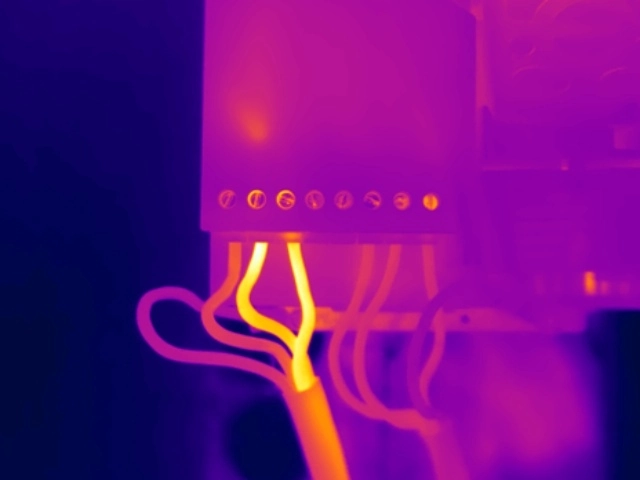
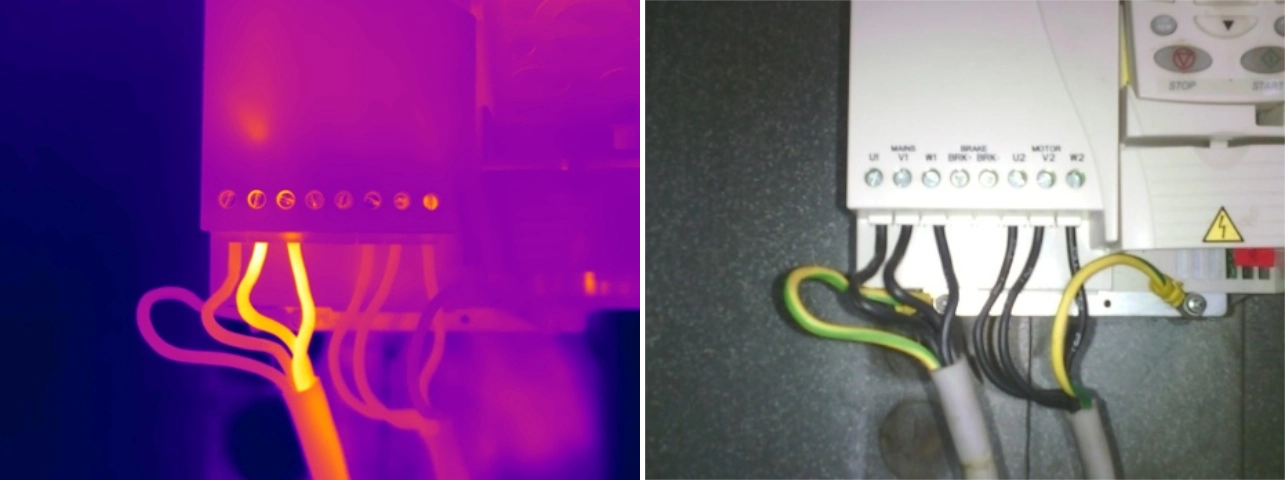
Differences at the output of an inverter or motor overload unit may indicate unequal current, downstream cable or connection issues, drive behaviour or a possible motor-winding problem. Further electrical investigation is needed to determine the cause.
In systems with substantial single-phase or non-linear loads, imbalance can also increase neutral current and affect transformers, distribution equipment and overall system efficiency.
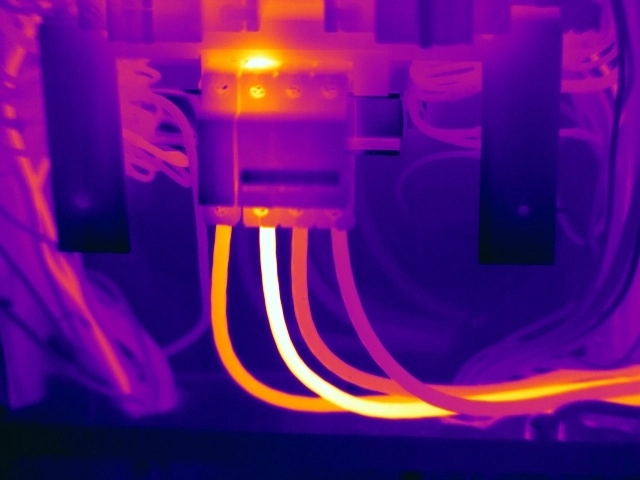
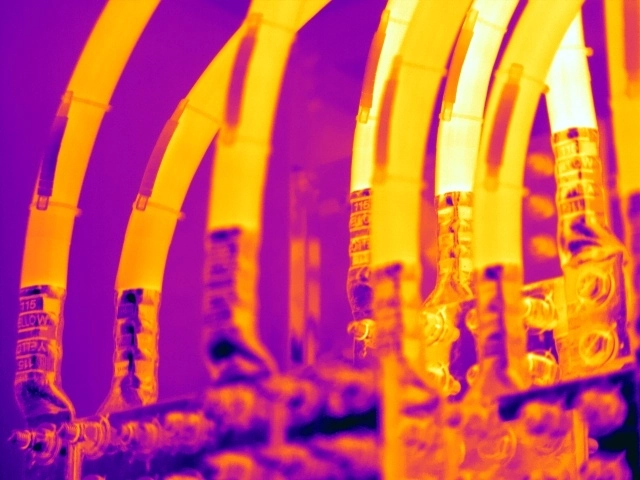
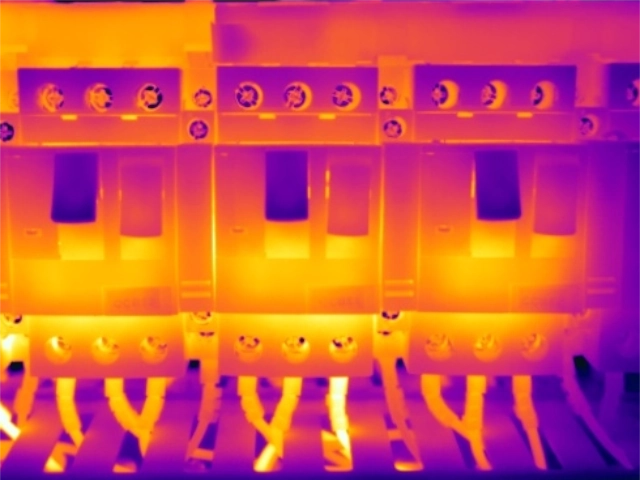
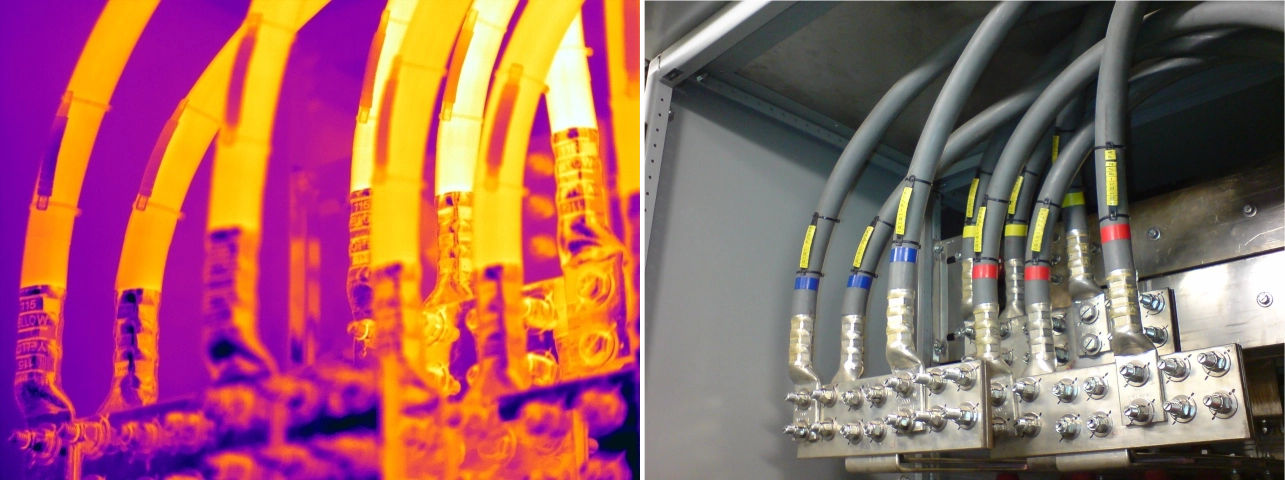
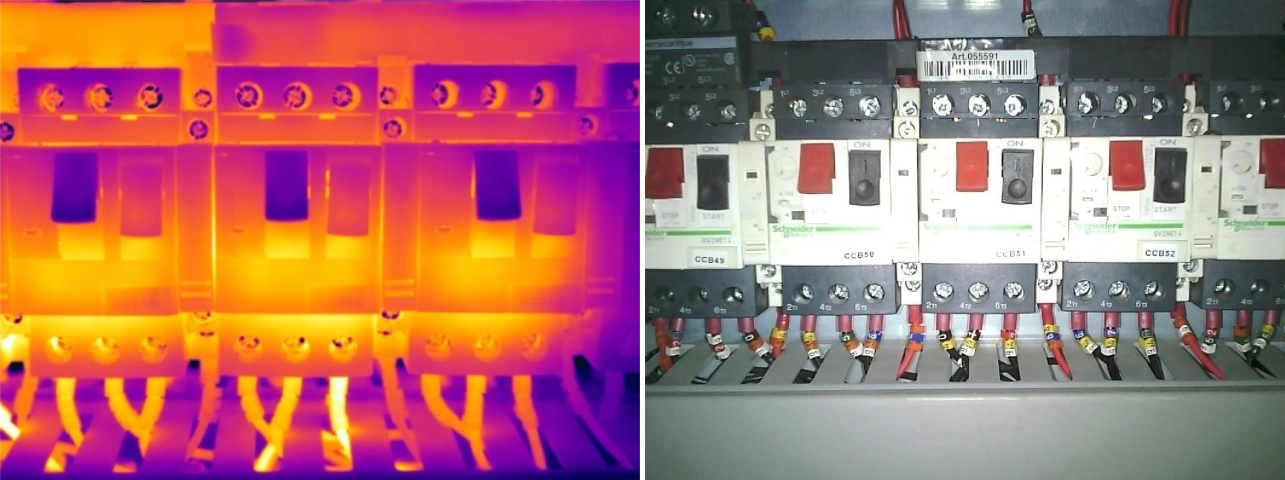
Phase imbalance can present at main incomers, drive outputs and motor circuits. The two examples below add an LV switch-panel incomer and motor-overload circuit to the distribution-board and inverter examples shown above.
Red Current can compare phase temperatures under representative operating conditions, provide clear thermal and visual evidence, and deliver an independently reviewed report with prioritised recommendations. We also support electrical testing companies requiring specialist thermography.
Phase imbalance may be found at distribution-board supplies, main switchboard incomers, busbars, transformers, motor control centres, variable-speed drives, motor overload units, UPS distribution and circuits with substantial single-phase demand.
The thermal pattern may continue along the affected phase, but localised heating at one point could instead indicate a loose or high-resistance connection. Phase-current measurements and knowledge of the circuit are therefore important when separating a system-loading issue from a component defect.
The four examples on this page span main distribution, LV switchgear and motor circuits. Together they show that phase imbalance can be an upstream loading condition, a downstream motor-related symptom or a consequence of another electrical issue.
Thermal imaging identifies where unequal phase behaviour warrants further investigation; it does not replace current measurement, electrical testing, load review or remedial work by an appropriately competent electrical contractor. Corrective action may include redistributing single-phase loads, investigating motor or cable conditions, reviewing drive output, correcting connection defects or addressing supply-side imbalance.
A follow-up thermal inspection under comparable operating conditions can help verify whether corrective work has improved phase temperatures. Where demand varies significantly, trend information or repeat inspection may be required before the result can be judged reliably.
Red Current can provide a specialist electrical thermal imaging survey or follow-up verification inspection under representative operating load. Our electrically qualified, ITC/PCN certified thermographers provide clear thermal and visual evidence, independently reviewed reporting and prioritised recommendations, while your electrical contractor remains responsible for electrical testing and remedial work.
A phase may be warmer because it carries greater load, but the origin may be circuit allocation, operational demand, a connection issue, supply imbalance or a downstream equipment condition.
Thermography shows the distribution of heat. Current and voltage measurements, equipment ratings and load information are needed to establish whether the system is electrically imbalanced and how significant the condition is.
Unequal temperatures at an inverter output or motor overload may indicate a motor winding, cable, connection or drive-related issue. The thermal pattern should direct further investigation rather than be treated as a final diagnosis.
The value of an electrical thermal imaging survey lies in converting thermal evidence and operational context into a defensible maintenance decision. Red Current’s assessments draw on electrical expertise, ITC/PCN certification, structured review and an in-house knowledge base developed from years of reporting data and millions of thermal images.
Electrical testing companies are frequently asked to add thermography to fixed-wire testing or maintenance programmes. Red Current can provide specialist image capture, interpretation and reporting while the electrical contractor retains the client relationship and responsibility for electrical testing or remedial work.
Realising the full value of an electrical thermal imaging survey depends on the competence of the thermographer, the quality of the inspection process and the clarity of the final report. Red Current combines electrical knowledge, certified thermography expertise and structured quality assurance to provide findings that can be understood, prioritised and acted upon.
Our electrical thermal imaging surveys are undertaken by electrically qualified, ITC/PCN certified thermographers. These recognised certification schemes provide structured training and assessment in infrared thermography, while our electrical qualifications and field experience support safe, technically informed inspection of live electrical systems. Thermographer competence matters because image capture, measurement, interpretation and reporting must be considered together.
Read more about why ITC/PCN thermography certification and surveyor competence matter.
Our survey and reporting processes are aligned with ISO 18434-1, supporting a consistent approach to inspection, analysis and communication of findings. Reports are prepared to give maintenance teams clear evidence, appropriate context and practical priorities.
See our guidance on electrical thermal imaging standards, reporting and survey requirements.
Thermal images alone do not provide a maintenance strategy. Our reporting process turns observations into documented findings with supporting thermal evidence, priority classifications and recommendations that can be used by facilities teams, insurers and electrical contractors.
Find out whether an electrical thermal imaging report can support insurance requirements.
Phase imbalance can affect distribution systems, transformers, motor circuits, drives and critical electrical infrastructure. Red Current delivers electrical thermography across commercial, industrial and high-voltage environments, helping ensure thermal findings are assessed alongside the correct load, equipment and operational context.
Explore our common electrical faults guide and high-voltage thermal imaging surveys.
Phase imbalance can affect any three-phase installation, particularly where single-phase loads change, motor-driven processes are important or critical infrastructure depends on efficient and reliable distribution.
Thermal imaging can identify unequal phase behaviour and associated reliability concerns within electrical systems serving data centres.
Discover More
Thermal imaging can identify unequal phase behaviour and associated reliability concerns within electrical systems serving manufacturing facilities.
Discover More
Thermal imaging can identify unequal phase behaviour and associated reliability concerns within electrical systems serving high voltage substations.
Discover More
Thermal imaging can identify unequal phase behaviour and associated reliability concerns within electrical systems serving hospitals & healthcare facilities.
Discover More
Thermal imaging can identify unequal phase behaviour and associated reliability concerns within electrical systems serving distribution centres.
Discover More
Thermal imaging can identify unequal phase behaviour and associated reliability concerns within electrical systems serving food manufacturing facilities.
Discover More
Thermal imaging can identify unequal phase behaviour and associated reliability concerns within electrical systems serving commercial offices.
Discover More
Thermal imaging can identify unequal phase behaviour and associated reliability concerns within electrical systems serving schools, colleges & universities.
Discover More
Thermal imaging can identify unequal phase behaviour and associated reliability concerns within electrical systems serving shopping centres & retail parks.
Discover MoreCommon causes include uneven single-phase load distribution, operational changes, poor circuit allocation, supply voltage imbalance, connection issues, variable-speed drive conditions and motor or cable faults.
Thermal imaging can reveal unequal temperatures between equivalent phase conductors and components. Current and voltage measurements are normally needed to confirm the electrical imbalance and determine its significance.
No. A localised loose or high-resistance connection can also make one phase appear hotter. The complete thermal pattern, loading and electrical measurements must be assessed before the cause is determined.
Persistent current or voltage imbalance can increase motor heating, reduce efficiency and shorten equipment life. The severity depends on the degree of imbalance, motor design, loading and duration.
Uneven single-phase loading can increase neutral current. Non-linear loads may also affect neutral loading, so current measurements and system context are important.
Yes. Unequal thermal behaviour at an inverter output may indicate drive conditions, downstream cable or connection issues, or a possible motor problem. Further electrical investigation is required to identify the cause.
Prioritisation considers the measured or suspected imbalance, thermal pattern, equipment type, loading, asset criticality, possible failure consequences and operational risk.
Specialist thermographers interpret phase-to-phase thermal patterns alongside loading, equipment design and operating context, then communicate findings through consistent reporting and actionable recommendations.
For broader survey questions, visit our Electrical Thermal Imaging Survey FAQs.
Unequal phase temperatures can provide valuable evidence of loading or equipment conditions, but the cause cannot be established from temperature alone. Representative operating conditions, electrical measurements, comparative analysis and equipment knowledge are essential if findings are to support sound maintenance decisions.
Red Current provides specialist electrical thermography for end users, facilities teams, insurers and electrical testing companies throughout the UK. Contact us to request pricing, obtain a sample report or discuss a subcontract survey requirement.
Please complete the form below to let us know your requirements. We’ll then provide detailed information on costs and our inspection process.
Please complete the form below to let us know your requirements. We’ll then provide detailed information on costs and our inspection process.
Please complete the form below to let us know your requirements. We’ll then provide detailed information on costs and our inspection process.
Please complete the form below to let us know your requirements. We’ll then provide detailed information on costs and our inspection process.
Please complete the form below to let us know your requirements. We’ll then provide detailed information on costs and our inspection process.
Please complete the form below to let us know your requirements. We’ll then provide detailed information on costs and our inspection process.
Please complete the form below to let us know your requirements. We’ll then provide detailed information on costs and our inspection process.
Please complete the form below to let us know your requirements. We’ll then provide detailed information on costs and our inspection process.
Please complete the form below to let us know your requirements. We’ll then provide detailed information on costs and our inspection process.
Please complete the form below to discover our latest offers on the camera you're interested in.
Please fill out this form for us to generate an invoice. Call us on 0118 3320819 or email your enquiry to our team who are on hand to assist.
Please complete the form below to discover our latest offers on the camera you're interested in.
Please complete the form below to let us know your requirements. We’ll provide detailed information on pricing, availability, delivery options, and our thermal camera hire process.
Once submitted, a member of our team will get in touch with tailored guidance to support your needs.
 ELECTRICAL APPLICATIONSData Centre Thermal InspectionsHigh Voltage Substation SurveysManufacturing Facility InspectionsHospital Thermal InspectionsFood Manufacturing InspectionsDistribution Centre InspectionsOffice Building InspectionsSchool & University InspectionsShopping Centre InspectionsOffshore Oil and Gas Surveys
 OTHER APPLICATIONSUnder Floor Heating InspectionsBuilding Heatloss Surveys


