Data Centres
Thermal imaging can identify loading-related heating and potential capacity concerns within electrical systems serving data centres.
Discover MoreOverloaded circuits are regularly identified during electrical thermal imaging surveys and can affect supply cables, protective devices, busbars, switchgear and transformers across low-voltage and high-voltage systems.
Unlike many connection faults, overload-related heating does not necessarily indicate that the inspected component is defective. The thermal condition may instead reflect sustained current demand, inadequate capacity, changing operational requirements, added loads or poor load management.
Our electrical thermal imaging surveys provides a non-invasive way to assess electrical equipment while operating under representative load. This page explains how overloaded circuits appear thermally, why current and design context matter, and how findings can support capacity planning and maintenance decisions.
The operational significance varies according to the equipment and service supplied. Elevated temperatures within a final distribution circuit may require load review, while an overloaded transformer, main switch or critical busbar may threaten wider system reliability and continuity.
Effective assessment considers the extent and distribution of heating, conductor and protective-device ratings, electrical load, phase balance, ambient conditions, equipment construction and the consequences of failure. This is more complex than simply identifying which component appears hottest.
For a wider overview, visit our Common Electrical Faults Identified by Thermal Imaging guide. Related load-related anomalies are also discussed within our electrical thermal imaging survey resources.
An electrical circuit is overloaded when current demand approaches or exceeds the capacity of the conductors, protective devices or connected distribution equipment for the prevailing operating conditions.
Overload-related heating often affects a wider section of the current path than a localised connection defect. Supply cables, breaker bodies, switch contacts or busbars may all operate at elevated temperatures because the entire circuit is carrying sustained load.
The thermal pattern must be considered alongside measured load, equipment ratings, installation method, ambient temperature and duty cycle. A thermogram can identify abnormal operating conditions, but it does not by itself confirm the design capacity or required corrective action.
As current increases, resistive heating rises throughout conductors and components in the current path. Sustained demand can therefore elevate the temperature of cables, breakers, busbars, switches and transformers.
Additional equipment, production changes, EV charging, cooling demand or growth in connected load can move circuits closer to their design capacity even where the original installation was suitable.
Overload conditions may create broad, relatively uniform heating rather than one isolated hotspot. Thermographers therefore evaluate the complete thermal pattern and compare it with loading, ratings and similar equipment.
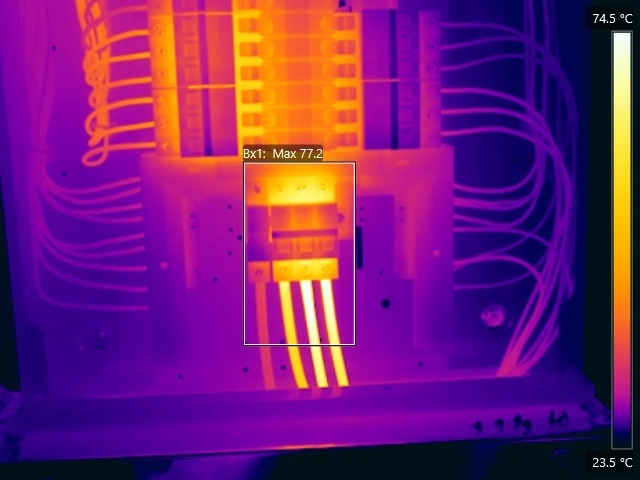
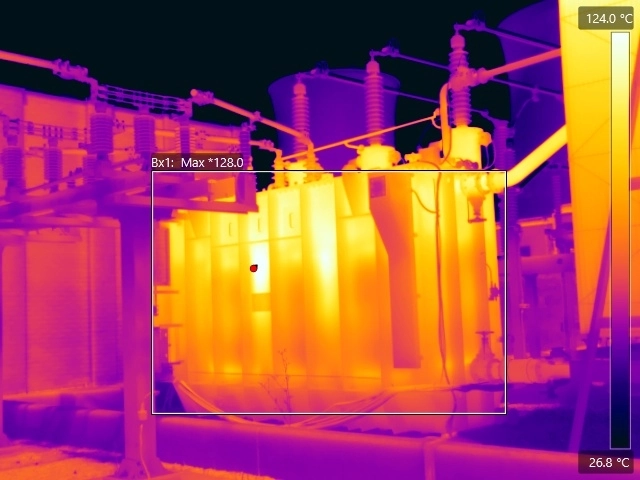
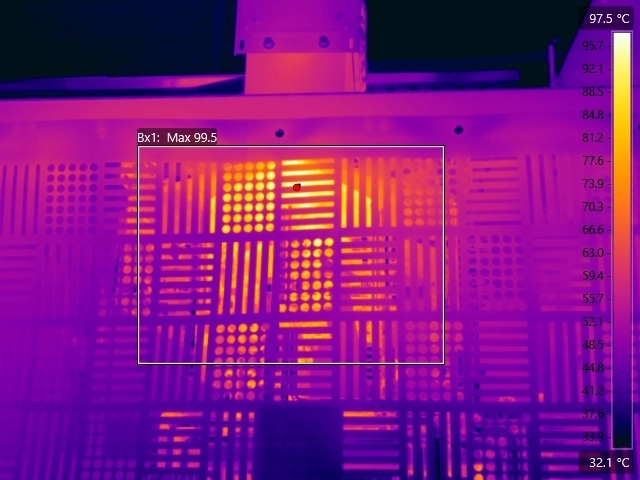
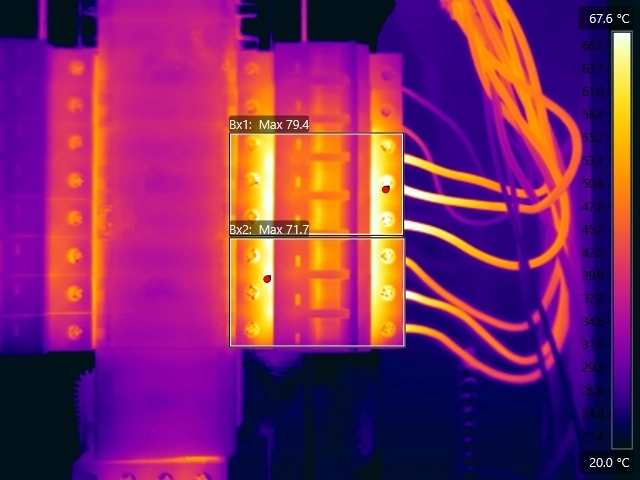
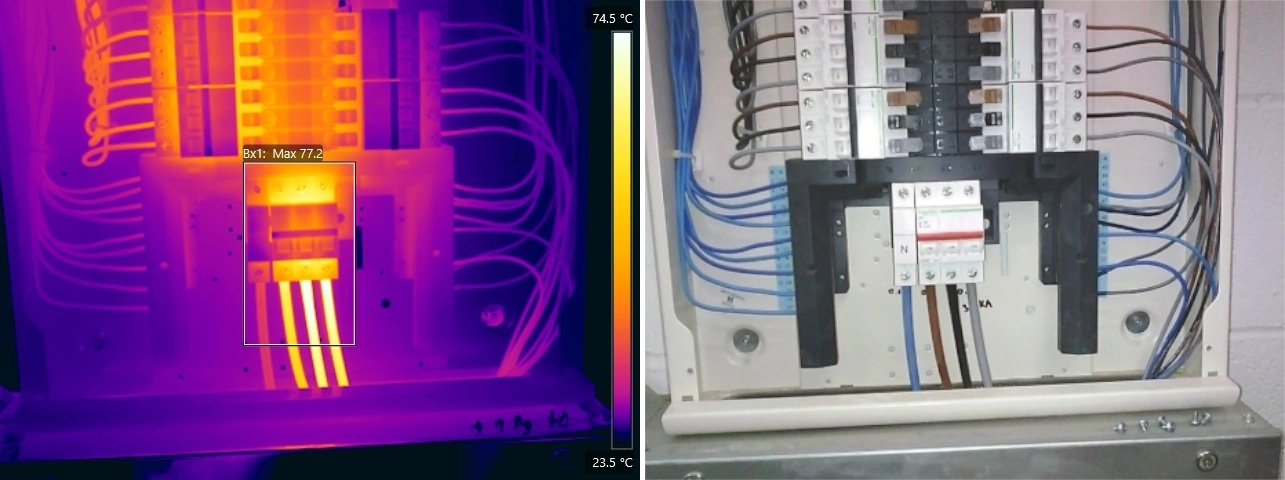
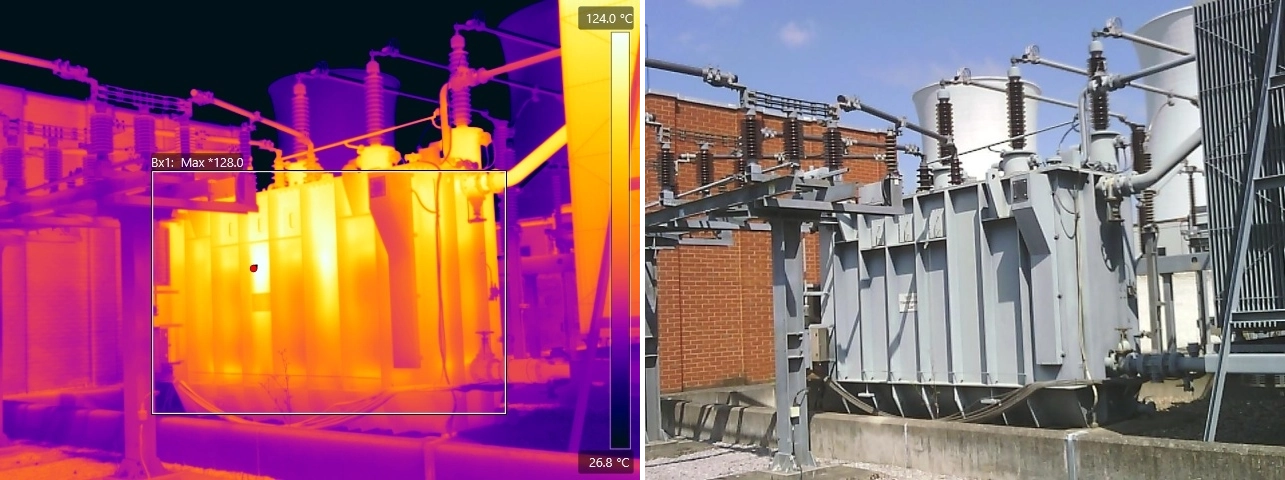
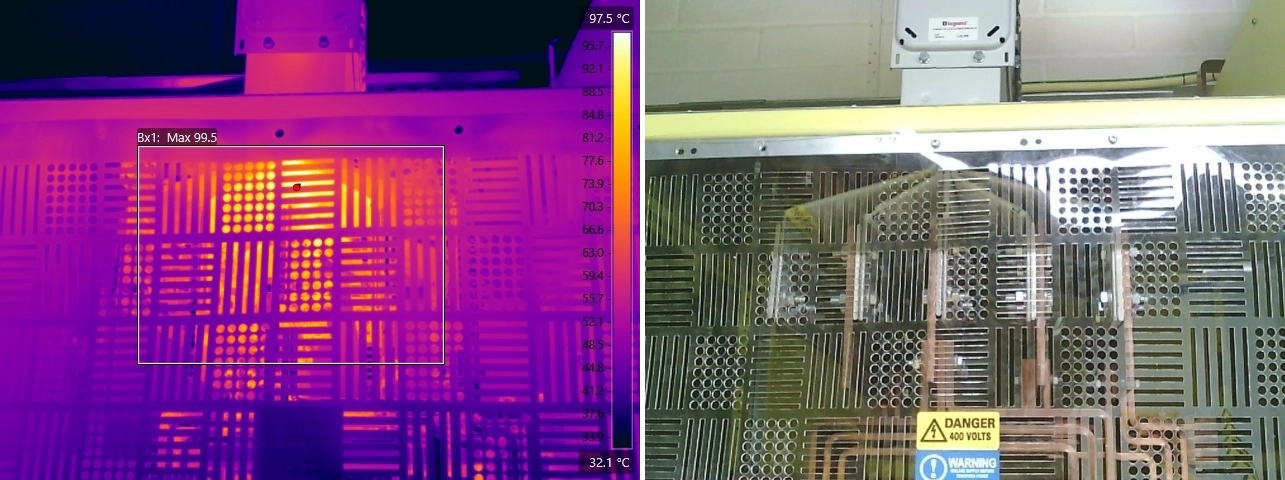
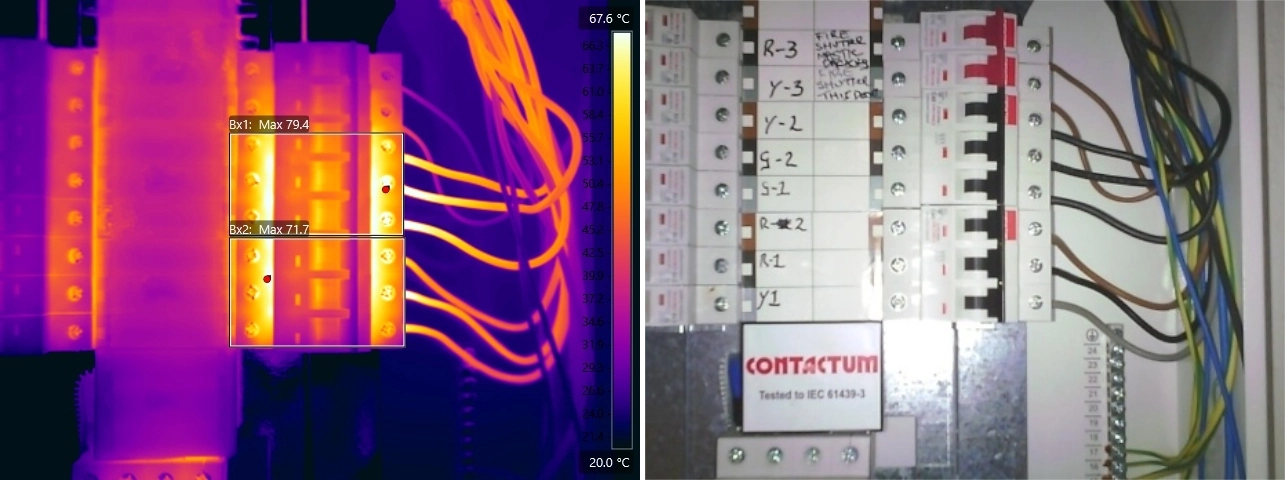
Overload-related thermal patterns can occur within high-current distribution and final distribution equipment. The examples below add a data centre busbar and EV-charging distribution board to the supply-cable and transformer examples shown above.
Red Current can assess live electrical equipment under representative operating conditions, document thermal behaviour and provide an independently reviewed report with prioritised recommendations. We also support electrical testing companies requiring specialist thermography.
Overload conditions may affect distribution-board incomers, final circuits, main switches, busbars, power distribution units, transformers, UPS distribution and circuits supplying high-demand equipment such as EV chargers, HVAC systems and industrial processes.
The thermal pattern often extends across conductors and equipment in the same current path. This differs from a localised high-resistance connection, although both conditions can coexist and require careful interpretation.
The four examples on this page span a three-phase distribution-board supply, a 132kV transformer, a data centre busbar and MCBs supplying EV chargers. Together they illustrate overload behaviour across very different voltage levels and applications.
Thermal imaging identifies where loading-related heating warrants investigation; it does not replace electrical design review, load measurement or remedial work by an appropriately competent electrical contractor. Corrective action may include redistributing loads, reducing demand, upgrading conductors or protective devices, increasing infrastructure capacity or reviewing operational duty.
A follow-up inspection under representative load can help confirm whether corrective measures have reduced the thermal condition. Where operating demand varies significantly, monitoring across suitable load periods may be required before judging the effectiveness of the action.
Red Current can provide a specialist electrical thermal imaging survey or follow-up verification inspection under representative operating load. Our electrically qualified, ITC/PCN certified thermographers provide clear thermal and visual evidence, independently reviewed reporting and prioritised recommendations, while your electrical contractor or design team retains responsibility for load calculations and remedial work.
Equipment carrying substantial but permissible load may operate at elevated temperature. The result must be compared with ratings, current measurements, duty cycle and installation conditions before overload is concluded.
Heating concentrated at one termination may be more consistent with a loose or high-resistance connection than whole-circuit overloading. Pattern recognition is therefore as important as temperature.
Production cycles, cooling demand, EV charging and equipment diversity can alter current during an inspection. The thermographer must relate the thermal image to representative operating conditions.
The value of an electrical thermal imaging survey lies in converting thermal evidence and load context into a defensible maintenance or capacity decision. Red Current’s assessments draw on electrical expertise, ITC/PCN certification, structured review and an in-house knowledge base developed from years of reporting data and millions of thermal images.
Electrical testing companies are frequently asked to add thermography to fixed-wire testing or maintenance programmes. Red Current can provide specialist image capture, analysis and reporting while the electrical contractor retains the client relationship and responsibility for design calculations or remedial work.
Realising the full value of an electrical thermal imaging survey depends on the competence of the thermographer, the quality of the inspection process and the clarity of the final report. Red Current combines electrical knowledge, certified thermography expertise and structured quality assurance to provide findings that can be understood, prioritised and acted upon.
Our electrical thermal imaging surveys are undertaken by electrically qualified, ITC/PCN certified thermographers. These recognised certification schemes provide structured training and assessment in infrared thermography, while our electrical qualifications and field experience support safe, technically informed inspection of live electrical systems. Thermographer competence matters because image capture, measurement, interpretation and reporting must be considered together.
Read more about why ITC/PCN thermography certification and surveyor competence matter.
Our survey and reporting processes are aligned with ISO 18434-1, supporting a consistent approach to inspection, analysis and communication of findings. Reports are prepared to give maintenance teams clear evidence, appropriate context and practical priorities.
See our guidance on electrical thermal imaging standards, reporting and survey requirements.
Thermal images alone do not provide a maintenance strategy. Our reporting process turns observations into documented findings with supporting thermal evidence, priority classifications and recommendations that can be used by facilities teams, insurers and electrical contractors.
Find out whether an electrical thermal imaging report can support insurance requirements.
Overload conditions can affect final circuits, distribution boards, busbars, transformers and high-voltage assets. Red Current delivers electrical thermography across commercial, industrial and critical infrastructure environments, helping ensure thermal findings are considered alongside the correct load and operational context.
Explore our common electrical faults guide and high-voltage thermal imaging surveys.
Overloaded circuits can develop across all electrical environments, particularly where operational demand changes, connected loads grow or critical infrastructure operates close to capacity.
Thermal imaging can identify loading-related heating and potential capacity concerns within electrical systems serving data centres.
Discover More
Thermal imaging can identify loading-related heating and potential capacity concerns within electrical systems serving manufacturing facilities.
Discover More
Thermal imaging can identify loading-related heating and potential capacity concerns within electrical systems serving high voltage substations.
Discover More
Thermal imaging can identify loading-related heating and potential capacity concerns within electrical systems serving hospitals & healthcare facilities.
Discover More
Thermal imaging can identify loading-related heating and potential capacity concerns within electrical systems serving distribution centres.
Discover More
Thermal imaging can identify loading-related heating and potential capacity concerns within electrical systems serving food manufacturing facilities.
Discover More
Thermal imaging can identify loading-related heating and potential capacity concerns within electrical systems serving commercial offices.
Discover More
Thermal imaging can identify loading-related heating and potential capacity concerns within electrical systems serving schools, colleges & universities.
Discover More
Thermal imaging can identify loading-related heating and potential capacity concerns within electrical systems serving shopping centres & retail parks.
Discover MoreCommon causes include increased operational demand, additional connected equipment, poor load distribution, process changes, EV charging and infrastructure operating close to its intended capacity.
Yes. Thermal imaging can show elevated temperatures across conductors, breakers, busbars, switches and transformers while equipment operates under load. Current measurements and equipment ratings are also needed to confirm significance.
No. Heating may arise from normal load, a loose or high-resistance connection, component deterioration, adjacent heat sources or environmental conditions. The complete thermal pattern and electrical context must be assessed.
Overloading often creates broader or more uniform heating across conductors and devices in the same current path, rather than one isolated hotspot. The pattern varies with load, equipment design and cooling.
Sustained excessive heating can accelerate insulation ageing, damage equipment and increase the risk of failure or fire. The actual risk depends on loading, protection, installation conditions and the affected asset.
EV charging can add sustained electrical demand. Whether this creates an overload depends on system capacity, load management, diversity, protective-device ratings and the wider installation design.
Prioritisation considers thermal behaviour, measured or representative load, equipment ratings, asset criticality, failure consequences and operational risk rather than temperature alone.
Specialist thermographers interpret thermal patterns alongside loading, equipment construction and operating context, then communicate findings through consistent reporting and actionable recommendations.
For broader survey questions, visit our Electrical Thermal Imaging Survey FAQs.
Overload-related heating cannot be assessed by temperature alone. Representative operating conditions, current measurements, equipment ratings, comparative analysis and an understanding of failure consequences are essential if thermal findings are to support sound maintenance and capacity decisions.
Red Current provides specialist electrical thermography for end users, facilities teams, insurers and electrical testing companies throughout the UK. Contact us to request pricing, obtain a sample report or discuss a subcontract survey requirement.
Please complete the form below to let us know your requirements. We’ll then provide detailed information on costs and our inspection process.
Please complete the form below to let us know your requirements. We’ll then provide detailed information on costs and our inspection process.
Please complete the form below to let us know your requirements. We’ll then provide detailed information on costs and our inspection process.
Please complete the form below to let us know your requirements. We’ll then provide detailed information on costs and our inspection process.
Please complete the form below to let us know your requirements. We’ll then provide detailed information on costs and our inspection process.
Please complete the form below to let us know your requirements. We’ll then provide detailed information on costs and our inspection process.
Please complete the form below to let us know your requirements. We’ll then provide detailed information on costs and our inspection process.
Please complete the form below to let us know your requirements. We’ll then provide detailed information on costs and our inspection process.
Please complete the form below to let us know your requirements. We’ll then provide detailed information on costs and our inspection process.
Please complete the form below to discover our latest offers on the camera you're interested in.
Please fill out this form for us to generate an invoice. Call us on 0118 3320819 or email your enquiry to our team who are on hand to assist.
Please complete the form below to discover our latest offers on the camera you're interested in.
Please complete the form below to let us know your requirements. We’ll provide detailed information on pricing, availability, delivery options, and our thermal camera hire process.
Once submitted, a member of our team will get in touch with tailored guidance to support your needs.
 ELECTRICAL APPLICATIONSData Centre Thermal InspectionsHigh Voltage Substation SurveysManufacturing Facility InspectionsHospital Thermal InspectionsFood Manufacturing InspectionsDistribution Centre InspectionsOffice Building InspectionsSchool & University InspectionsShopping Centre InspectionsOffshore Oil and Gas Surveys
 OTHER APPLICATIONSUnder Floor Heating InspectionsBuilding Heatloss Surveys


